An online dashboard is a cloud-based dashboard you build, run, and share entirely from your browser — no server, no local install. Dashboard Builder's Online Dashboard is the SaaS version of our on-premises tool: sign up, connect your data, and publish a live, embeddable dashboard in minutes.
What Is an Online Dashboard?
An online dashboard is a web-based tool for designing and displaying data-driven dashboards through a graphical interface — with no software to install. You log in from any browser to build, update, and manage your dashboards from anywhere, on any internet-connected device.
This is the cloud counterpart to our self-hosted Dashboard Builder software: same drag-and-drop engine, delivered as a Software-as-a-Service so there's nothing to host or maintain yourself.
Why Choose an Online Dashboard?
Unlike a desktop or self-hosted application, an online dashboard gives you flexibility and accessibility without any server setup. With cloud technology, you create, update, and share dashboards effortlessly — from a laptop, tablet, or phone, tracking your KPIs in real time wherever you are.
How to Build an Online Dashboard (Step-by-Step)
Setting up your first online dashboard takes about five minutes, start to finish.
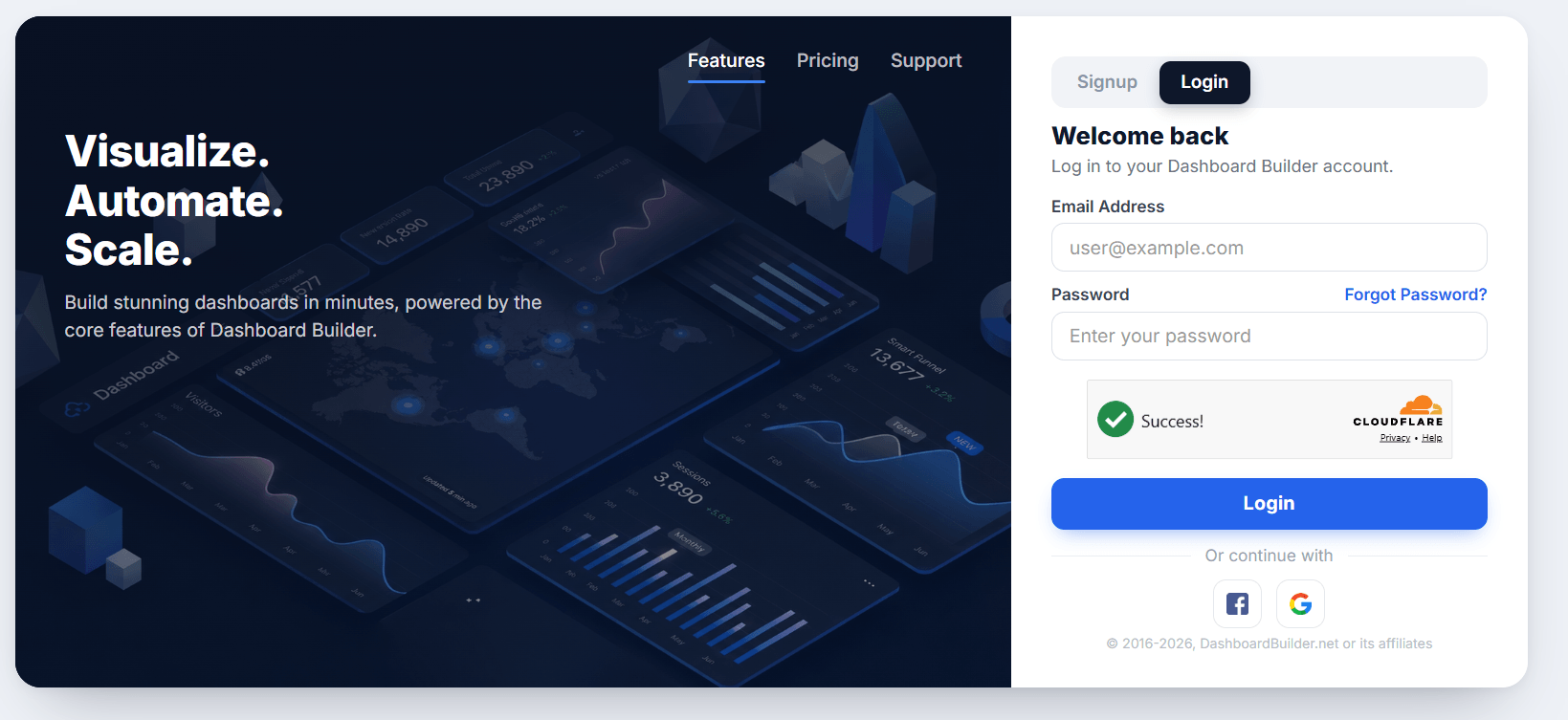
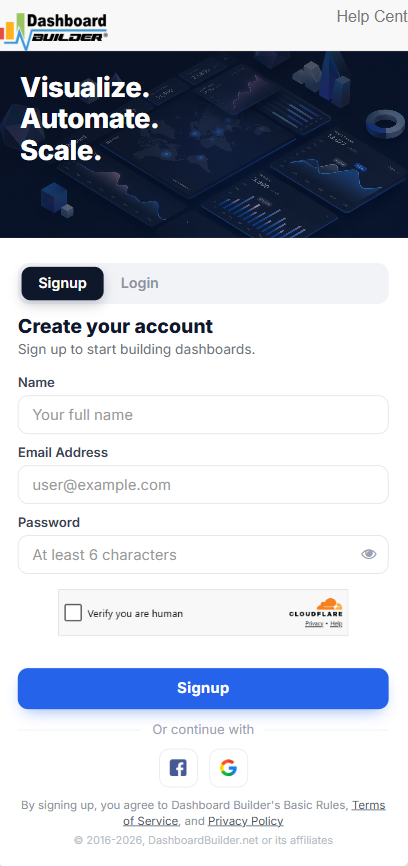
Sign up and enter your domain information. Create your free account, then open the preferences menu and add your website domain if you plan to embed your dashboard elsewhere. If you're not embedding it, you can skip this step.
Launch your dashboard. Click the Launch Dashboard button in the left navigation menu to open the builder.
Connect your database. Click the Database icon, select your data source (MySQL, PostgreSQL, SQLite, and more are supported), enter your credentials, and save. A green checkmark confirms the connection.
- When you click the save changes, a green tick mark with Database will appear that shows that your database is successfully connected.
- If you see a red cross sign that means the connection with database is unsuccessful. Make sure that your database is accessible remotely to %.dashboardbuilder.net
Go to your Cpanel and click the Remote MySQL link under the Databases tab

Enter %dashboardbuilder.net in the host field and click Add Host button

Configure your chart and run your SQL. Select the gear icon to see your available tables, enter or generate your SQL query, then click Run Query and assign the results to your X and Y axes.
Adjust size and position. Drag the chart panel's corner to resize or reposition it — layout is fully responsive on the Bootstrap framework.
Generate your universal code. Click Generate to produce embeddable HTML you can drop into any website or application.
Ready to try it? Sign up free and build your first online dashboard today.
Embedding Your Dashboard Anywhere
Once generated, your dashboard's universal HTML code can be embedded on any platform — no matter what your site is built on:
<div class="mychart">
  <object type="text/html" data="https://cloud.dashboardbuilder.net/apps-63/?param=..." style="width:100%; height:100%;"></object>
</div>
This code is released under the MIT license, so you're free to customize and reuse it anywhere. Browse Online Dashboard Examples for inspiration.
Data Security & Privacy
Your data is protected with industry-standard encryption, secure access protocols, and regular backups, alongside physical security practices, network security, and business continuity protocols. Read the full Privacy Policy for details on how your information is collected, used, and protected.
Requirements & Pricing
Online Dashboard runs on any SVG-compatible browser, so there's nothing to install and no OS restrictions to worry about. It operates as a Software-as-a-Service (SaaS) application — no license fee, no server to maintain, with flexible plans you can upgrade or downgrade as your needs change.
New accounts get a 14-day free trial with no credit card required — sign up with Google, Facebook, or LinkedIn and start building immediately. See full plan details on the pricing page.
Prefer to run your own server instead of the cloud? See PHP Dashboard or Real-Time Dashboard for the self-hosted version of this same engine.